
On December 5, 1888, the Russian Tsar allocated a plot of land in the center of Mažeikiai, on the current Laisvės Street between the gymnasium and the municipality buildings, for the construction of a church school. In 1894, an Orthodox church and school were opened. On November 25, the church was consecrated in the name of the Holy Spirit. The Telšiai Orthodox priest Gaurilas Zasimovičius took care of the construction. Funds for this construction were allocated by the Petersburg merchant IS Kručkovas, the Kronstadt merchant IA Kozlovskis, and local Orthodox Christians. The church was built on stone foundations with a bell tower and porch. The roof is covered with tin. The church school was attended by Russian and other nationalities living in the city of Mažeikiai and its surroundings, as well as Lithuanians who worked in the railway service. In 1898, In 1899, the elder of the church was Nikolaj Fiodorovič Malcev, the deputy head of the Mažeikiai railway station. In 1899, the senior telegrapher of the railway station, Nikolaj Vasiljevič Mate...oč, began to hold this position. He discovered it and sent a priest from the Viekšniai Orthodox church to perform religious duties. In 1905, the church was painted blue. When the First World War broke out, most of the Russians moved to Russia, and the school was closed. The German army, having occupied Mažeikiai, installed stables in the church.
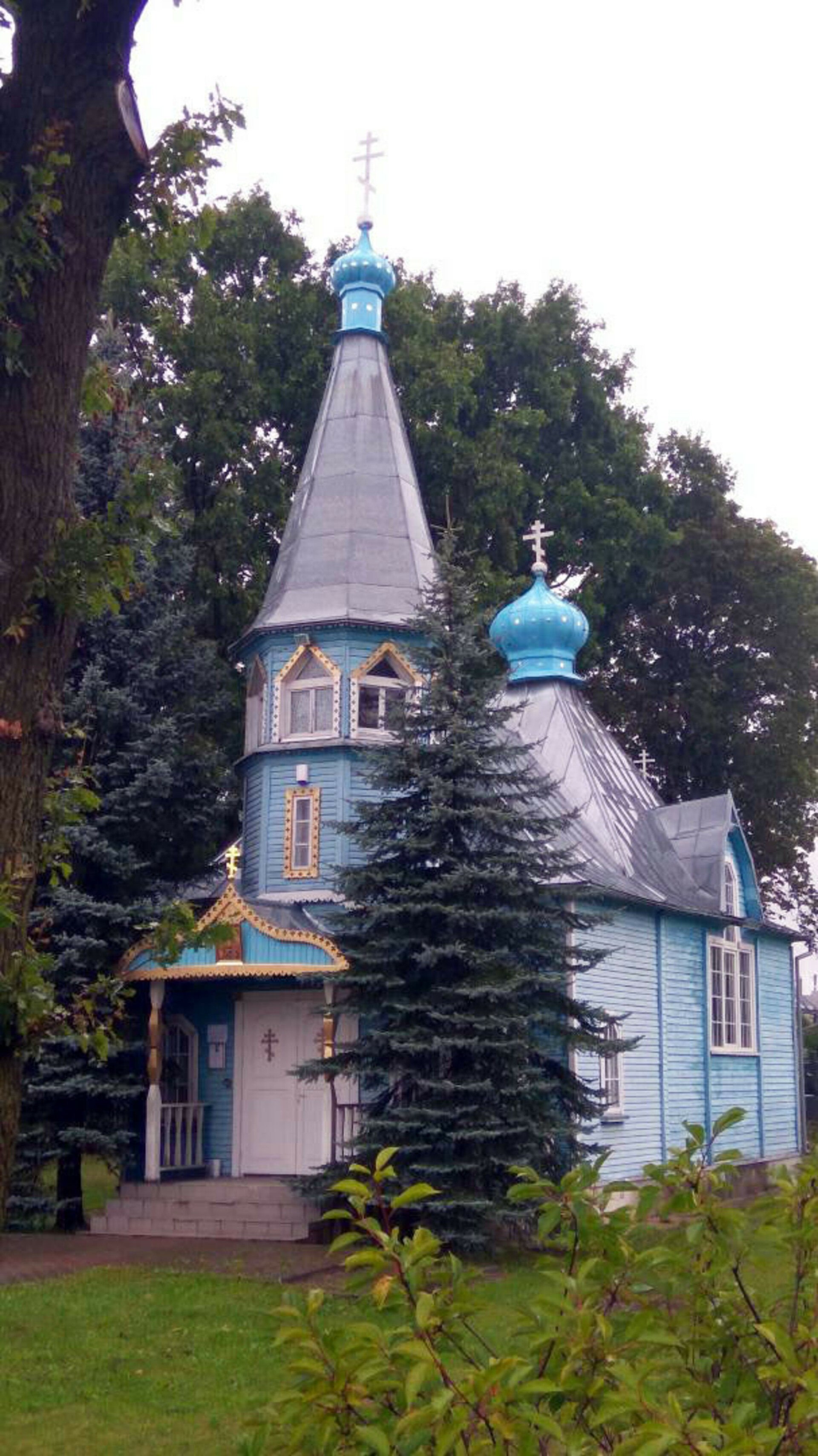
In 1929, the Orthodox community had about 300 believers. The Orthodox community saved over 12,000 litas for the construction of a new church. The government allocated a plot of land and 5,000 litas free of charge. The church committee had accumulated construction wood. About 5,000 litas were received from its sale. In 1929, the architect V. Kopylovas from Kaunas prepared a project for the current church. On May 13, a permit was received for the construction of a church on Nepriklausombys Street (now - Respublikos St.). Construction proceeded rapidly, because already on July 30, 1930, the Church Community Committee obliged Anastasia Semionovna Korženeckaja from the Alytus Orthodox Church, in coordination with the State Ministry of War, to transport holy icons and other cult paraphernalia. The construction and equipment of the church were taken care of by priest Aleksandras Družilovskis, members of the construction committee S.Tomanov, Vladas Burba and Jekaterina Burbienė. The church began operating in 1931, it was named the Church of the Assumption of the Mother of God. In the pre-war years, the church was widely visited and had a large choir. The united choirs of Viekšniai and Mažeikiai churches held public concerts on August 16 and 23, 1936. The joint choir was led by IFPetrov, the head of the choir of the Kaunas Orthodox Eparchy. Hymns and songs of religious and secular content were performed. A particularly solemn feast was held to mark the 25th anniversary of the activities of the Metropolitan of Kaunas Orthodox Church. The Sisterhood of St. Sergius of Radonezh was formed. It took care of the elderly and orphans. That same fall of 1936, Bishop Steponas Giniotis of the Lithuanian American Community visited the churches of Viekšniai and Mažeikiai. Once a year, the Metropolitan of the Kaunas Orthodox Eparchy visited the church.
Most of the Russian-speaking residents of Mažeikiai were believers and visited the church in large numbers. The church was not severely damaged during World War II. In 1947, an Orthodox parish was officially registered. After the war, the priests changed, and the number of believers was constantly decreasing. Only after the restoration of Lithuania's independence did the church revive. Every Sunday morning, masses are held here, children are baptized, funeral rites are held, and all Orthodox religious holidays are held. Priest Nestoras arrives from Telšiai every Sunday. A Russian Sunday school operates near the church, where children are prepared for church holidays, introduced to the history, customs, and traditions of the church, and learn to serve Mass. The church choir is led by regent Margarita Mašina, a master of the Lithuanian Academy of Music. There is a small hospital near the church, which has a small library. It is now led by Anisa Dauskurtienė. In addition to the choir at the church, the Russian community has assembled a group of singing teachers who perform during various holidays and outings.
Reviews